Write to us
the fields marked with * are mandatory

Many tumors remain unnoticed for a long time in their early stages because they initially cause no clear symptoms. Screening can help make suspicious changes visible before they cause noticeable problems. Whole-body MRI offers a particular option for this purpose: it examines large areas of the body using detailed cross-sectional images without radiation exposure. Organs, soft tissues, bone structures and lymph nodes can therefore be assessed precisely. The examination can provide indications of changes that may be suspicious for tumors and complement conventional cancer screening with a comprehensive view inside the body. Below, we provide detailed information about this examination.
Various established examinations are available today for the early detection of cancer. Many screening programs focus on individual organs or regions of the body and provide an important basis for assessing personal risks.
Conventional examinations include skin cancer screening, colonoscopy for the early detection of bowel cancer, mammography for breast cancer screening and gynecological and urological preventive examinations. Laboratory values, ultrasound and similar examinations may also be useful depending on age, sex, symptoms and family history.
These established examinations are particularly valuable because they target specific types of cancer or areas of risk. At the same time, they generally focus on individual organ systems. Whole-body MRI can therefore complement conventional screening by allowing many regions of the body to be assessed at the same time.
For people who want to go beyond conventional screening examinations, whole-body MRI at our radiological prevention center in Düsseldorf offers a particularly modern form of cancer screening. It enables detailed and gentle examination of large areas of the body without radiation exposure.
In a single examination, many organs, soft tissues, bone structures and blood vessels can be visualized precisely. This can allow us to detect suspicious changes that may indicate a tumor, often before the first symptoms occur.
Magnetic resonance imaging for cancer screening may be useful if you would like to supplement your conventional preventive diagnostics. For people with little time, it can provide a structured way to examine several relevant regions of the body in a single appointment.
The examination may be particularly suitable for:
If certain cancers occur more frequently in the family, extended preventive diagnostics may be useful. Whole-body MRI provides a comprehensive view of many regions of the body and can help make suspicious changes visible at an early stage.
Some patients do not want to wait until symptoms appear before taking action and prefer to keep an active eye on their health. Whole-body MRI offers a modern way of examining the body preventively and arranging further assessment of possible abnormalities.
Many tumors cause no clear symptoms at first. Magnetic resonance imaging can therefore be useful as an additional screening examination for detecting changes before they become noticeable.
Full calendars often leave little room for several separate screening appointments. Whole-body MRI combines the examination of many regions of the body into one appointment and can therefore complement preventive healthcare in a time-efficient and structured way.
Whole-body MRI can show many regions of the body in detail and therefore make suspicious changes visible that may indicate a tumor.
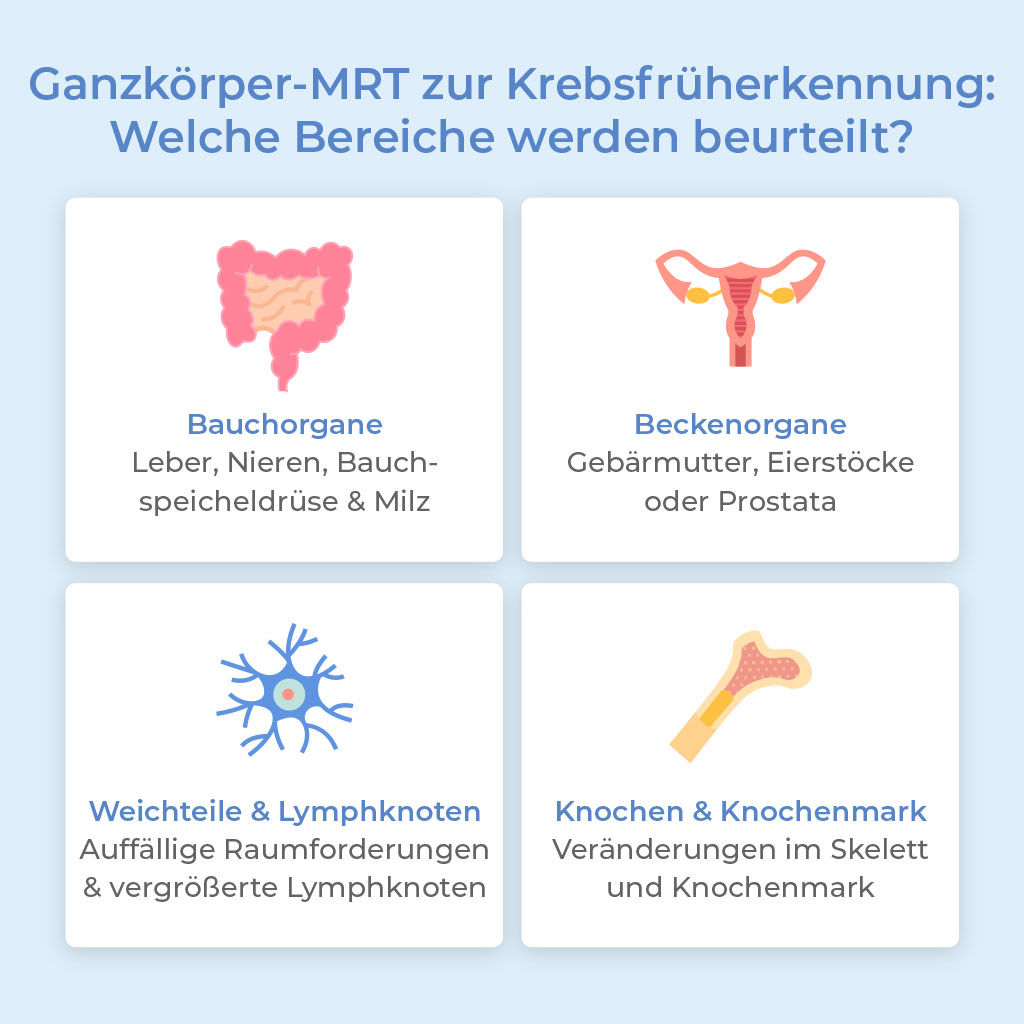
As part of cancer screening, the following can be assessed, among other areas:
These include, for example, the liver, kidneys, pancreas, spleen, uterus, ovaries or prostate.
MRI can make masses in muscles, fatty tissue or other soft-tissue structures visible, as well as enlarged lymph nodes.
Abnormalities in the skeletal system or bone marrow can also become visible.
We describe suspicious findings specifically in the radiological report, including their location, size, extent and appearance. Depending on the finding, further examinations such as ultrasound, laboratory testing, CT, organ-specific MRI or assessment by another specialist may follow.
If the findings are unremarkable, a follow-up interval of around two to five years may be appropriate. If there is a family history or a desire for particularly close monitoring, a shorter interval can be determined individually.
Because MRI does not use ionizing radiation, it is generally suitable for repeated examinations. Unlike X-ray imaging or computed tomography, it does not involve radiation exposure. Imaging is based on magnetic fields and radio waves and therefore provides a gentle way to visualize many regions of the body.

the fields marked with * are mandatory
At our Radiology Düsseldorf prevention center, we use modern MRI technology to complement your cancer screening. By visualizing organs, soft tissues, lymph nodes and bone structures, the examination provides a comprehensive radiological overview that can supply important information for early cancer detection.
Simply contact us to arrange an appointment!
Image material: © SewcreamStudio / stock.adobe.com, © 100% HAND-CRAFTED / stock.adobe.com